October reminded us of what happens when a market built around a single narrative begins to question that narrative. For months, artificial intelligence (AI) seemed to justify almost any valuation and investment. Now investors are wondering how much it will cost to develop and when it will become profitable.
We haven’t seen a broad market decline, but rather a rotation away from big tech toward sectors that have been less favored until now. The distinction matters: the market isn’t rejecting risk, but rather reassessing how much it’s willing to pay for certain expectations.
- S&P 500: -0.93%
- Nasdaq: -6.65%
- Stoxx Europe: +1.87%
- MSCI All Country World Index (EUR): -0.65% (the dollar rose 1.50%; the index in USD fell 1.69%)
- Global Fixed Income Index(EUR): +3.18% (the dollar rose 1.50%; the index in USD rose 1.62%)
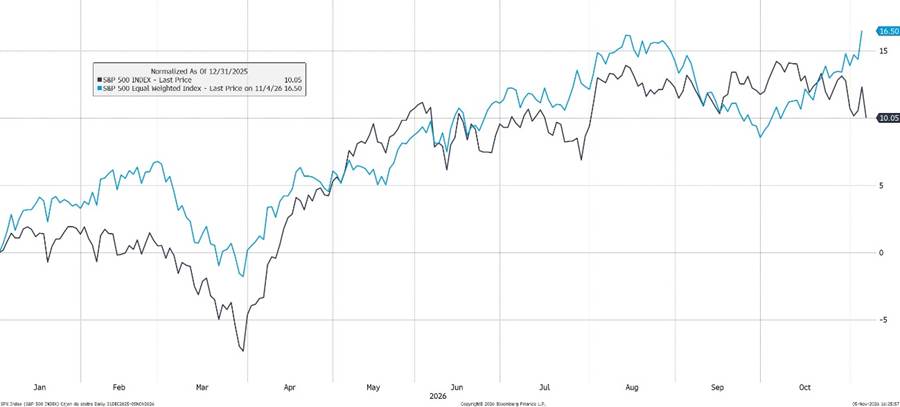
The S&P 500 cayó un 0,93%, but its equal-weight[1] version rose 5.0%. Large companies in traditional sectors gained 4.4%, while high-growth companies—primarily tech firms—fell 6.1%, and the Nasdaq 100 lost 6.65%.
Nine of the eleven sectors in the S&P 500 closed in positive territory. Energy (+14.0%), consumer staples (+11.6%), utilities (+10.2%), and healthcare (+9.9%) stood out; technology (-6.8%) and communications (-15.1%) declined. Rather than an indiscriminate flight from risk, this appears to be a reassessment of valuations.
Oil prices rose nearly 13% due to tensions surrounding the Strait of Hormuz, and U.S. inflation in September stood at 3.7%, up from 3.4% previously.
In the fixed-income market, the yield on the 10-year U.S. Treasury note fell from 5.24% to 4.93%. As we noted in August and September, we saw an opportunity in long-term bonds; the market has moved sooner and faster than expected.
In our August and September commentaries, we pointed out that there was an opportunity to increase exposure to long-term bonds. The market has moved sooner and more rapidly than anticipated. During October, the yield on 10-year U.S. Treasury bonds fell by approximately 31 basis points. This decline in yields resulted in a price appreciation of nearly 2.6% in the 7- to 10-year maturity segment.
I see this more as a search for refuge than as a firm commitment to immediate rate cuts.
The Problem of Concentration
The paradox of October is that the S&P 500 fell while nine of its eleven sectors rose. Buying the index does not always provide the diversification we imagine; a few tech companies with expectations tied to AI account for a large portion of the index. The chart shows how much the result changes when all companies are equally weighted.
The difference between the S&P 500 and its equally weighted version illustrates why it is not enough to simply look at the index’s return; it also matters which companies drive its performance. In this chart, the light blue line represents the equally weighted S&P 500, while the dark blue line corresponds to the traditional S&P 500. Since early October, the equally weighted index has outperformed.
Source: Bloomberg
What’s happening with artificial intelligence?
As we noted in September, semiconductor stocks had risen 10%; in October, they corrected by 16%. I don’t think investors have lost faith in AI, but rather they’re beginning to wonder how much the infrastructure will cost and what returns it will generate. Building data centers, purchasing chips, and securing computing power requires enormous investments, which sometimes outpace cash generation. An economic revolution, on its own, does not guarantee a profitable investment for all its financiers.
It’s important to distinguish between a major economic opportunity and a major opportunity for investors. Just because artificial intelligence boosts business productivity doesn’t necessarily mean that all the companies building the infrastructure will see extraordinary returns. If several companies compete to have more data centers, more chips, and more capacity, they may end up investing before they know how much they’ll be able to charge for it all. And the market—which for months seemed willing to finance practically any project—is starting to demand answers.
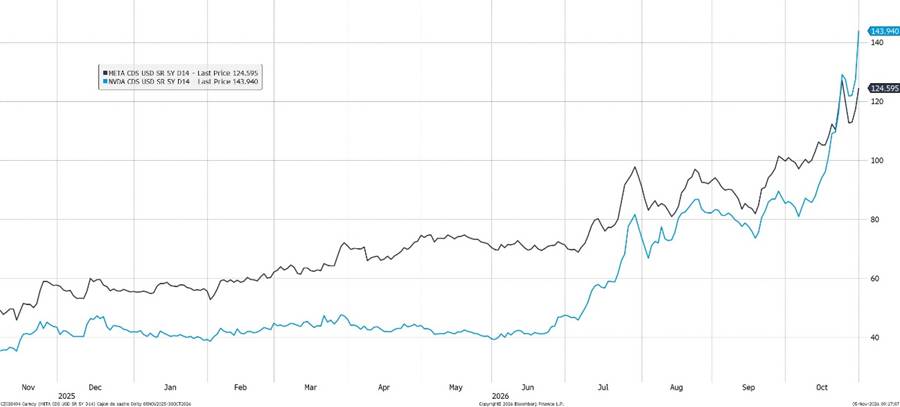
Alphabet fell 18.35% and 12.29% over the month following the release of its earnings; Meta fell 15%, and Nvidia fell 11%. But there is a less visible indicator that deserves our attention: the cost of insuring these companies’ debt through CDS[2], or credit default swaps. Put simply, it is the price paid to protect against a potential default.
Meta’s and Nvidia’s five-year CDS spreads reached around 124 and 144 basis points, respectively. At those levels, protecting $1 million in debt would cost about $12,400 and $14,400 annually. This is not a forecast of default, but rather a measure of the price the market assigns to risk. This chart reflects the sharp rise in CDS spreads, a sign that the market is beginning to perceive greater risk.
Source: Bloomberg
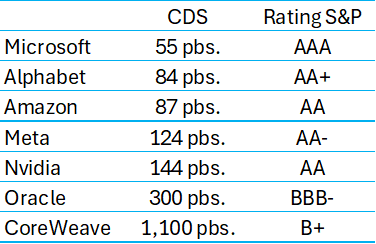
Is that a lot? It depends on who we’re comparing it to. The following table lists the CDS and rating[3] according to S&P.
Source: self-produced.
Neither Meta nor Nvidia appears to be on the verge of default; both maintain high credit ratings. What is revealing is that the market is beginning to demand a higher risk premium for risks previously considered secondary. Furthermore, demand for hedging linked to debt issuances can drive up CDS prices without a corresponding increase in the probability of default.
· Meta: Even a Good Business Can Spend Too Much
Meta maintains a profitable advertising business but is devoting enormous resources to AI. According to figures from the draft earnings report, on October 22 it raised its annual investment forecast to $135–145 billion and reported negative free cash flow. The question is: when will it be able to monetize that investment, how long will this effort last, and will it have to take on more debt?
It’s worth noting one nuance. When a lot of debt is issued, intermediaries may buy CDSs to hedge their positions. This demand can also drive up the price of CDSs, even without a corresponding increase in the probability of default. Therefore, a CDS is a warning sign, not a verdict.
· Nvidia: the Risk of Funding the Companies That Buy From You
Nvidia no longer just designs and sells chips to major tech companies; it also helps fund the ecosystem that buys them.
Nvidia has invested in CoreWeave, which builds data centers using its chips and rents out computing capacity. In addition to being a supplier and shareholder, Nvidia has committed to purchasing any capacity that CoreWeave is unable to rent out. Thus, chip sales, the value of its stake, and certain commercial commitments are tied to final demand for AI.
If that demand grows less than expected, CoreWeave could face underutilization and difficulties servicing its debt, while Nvidia would be exposed to lower sales, potential losses on its investment, and the cost of its commitments. This doesn’t mean it will happen, but it does mean that the risk extends throughout the financing chain.
CoreWeave illustrates this contrast; its CDS stands at 1,100 basis points. It is a capital- and debt-intensive business whose viability depends on continued growth in demand for AI capacity.
Private Credit: Who Is Financing All of This?
The big tech companies aren’t financing this expansion on their own. In addition to their own resources, they rely on debt markets and private credit.
Private credit consists of loans granted by funds and asset managers—such as Carlyle, Apollo, or Blackstone—rather than traditional banks. In exchange for higher returns, investors accept lower liquidity and less transparency regarding the pricing of these loans. Among those providing capital are pension funds, insurance companies, high-net-worth individuals, and retail investors through certain vehicles, such as BDC[4].
Private credit has grown because funds and investors have filled part of the gap left by banks. It offers potential returns in exchange for lower liquidity and transparency. The fact that a loan is not priced daily may smooth out apparent volatility, but it does not eliminate losses if the borrower runs into trouble.
The one warning of this risk is, in fact, one of the participants in this market. According to Carlyle’s October report[5], private credit could be called upon to finance nearly one trillion U.S. dollars in AI infrastructure—an amount equivalent to more than half of the assets currently managed by private credit vehicles. The warning makes perfect sense: when everyone wants to lend to the same business, there’s a risk of not charging enough to compensate for the risk being taken on.
Liquidity also matters: those who commit capital for years may find it difficult to exit if market sentiment shifts. The exits from certain credit vehicles in 2026, linked to concerns about software and AI, serve as a reminder that publishing prices less frequently does not make an investment safe.
There is another detail that I find particularly important: collateral. Lending against a building is not the same as lending against a fleet of chips. Buildings age, but GPUs[6] can become technologically obsolete in just a few years due to new generations of Nvidia products. Some loans also feature long-term contracts that provide some visibility into revenue. However, this can be a double-edged sword: if the business depends on a few large clients or cloud providers, the loss of even one of them can seriously compromise its ability to make payments.
We are not necessarily facing another crisis like the one in 2008. Today, part of the risk lies outside the banking system—in funds, insurance companies, pension funds, and investors. This changes the channels of contagion, but it does not eliminate potential losses or financial connections.
It’s important not to overstate the comparison with past crises. The fact that some of the risk lies with funds rather than banks changes how losses would be transmitted, but it doesn’t eliminate the connections between lenders, tech companies, and large clients. And there is one recurring pattern across many cycles: when very high growth is projected for too long, the margin of safety shrinks. The question we should be asking ourselves is not just how much an investment can gain if everything goes well, but what happens if the forecasts turn out to be overly optimistic.
The Question That Really Matters
In Antifragile[7], Nassim Taleb discussed “neomania”: our tendency to overvalue novelty and to confuse innovation with soundness. Artificial intelligence can transform the economy and, at the same time, lead to bad investments. These two statements are perfectly compatible.
Taleb helps us return to the beginning of this commentary. Just because something is new, useful, and has the potential to change the world does not automatically make all the assets purchased or financed around it sound. A GPU may be indispensable today but lose its economic value much sooner than expected if a more efficient generation emerges. And a company may have excellent customers but have taken on debt based on revenue that has not yet materialized. Innovation and financial prudence are not incompatible concepts; that is precisely why it is advisable to analyze them separately.
Themain question is this: What if the return on AI investments turns out to be lower than the cost of the capital needed to finance them? We don’t know the answer. But the stock market is already distinguishing between those who will benefit from AI and those who will bear the cost of building it, and the credit markets are beginning to price in that difference.
That is why I believe the October rotation toward energy, consumer staples, healthcare, and utilities is not a random move—nor is the divergence between the S&P 500 and its equally weighted version. Both remind us that a good story does not justify any price and that diversification means more than just buying many companies within the same index.
It’s important to put the risks into perspective. As I mentioned earlier, although spending on AI and its financing through private credit warrant caution, the situation is not comparable to the 2008 housing crisis: U.S. private debt is considerably lower, the major banks have stronger balance sheets, and part of the risk lies with institutions better equipped to absorb losses. There may be credit contagion, but today the risks appear to be more localized, and the financial system, in general, is better prepared. Prudence, yes; anticipating a crisis of similar magnitude, no.
As early as the 16th century, Diego de Covarrubias and Leyva[8] argued that the value of an asset depends on people’s perceptions of it, even when those perceptions are unreasonable. Markets continue to function in a similar way. We may be on the cusp of an extraordinary technological revolution, and yet we may still be paying too much to participate in it. That, to me, is the main lesson from October.
[1] In the equally weighted S&P 500, all companies have the same weight. In contrast, in the traditional index, each company’s weight depends on its market capitalization; the higher its market value, the greater its influence on the index.
[2] A CDS is a type of insurance that protects against the risk that a company will be unable to repay its debt. The more expensive it is, the greater the market’s concern about a potential default.
[3] It measures a company’s credit rating. S&P rates them from highest to lowest credit quality using the following nomenclature:
- Investment grade: AAA, AA+, AA, AA-, A+, A, A-, BBB+, BBB, BBB-.
- High-Yield: BB+, BB, BB-, B+, B, B−, CCC+, CCC, CCC−, CC, C, and D.
[4] Business Development Company. This is a type of U.S. investment vehicle, created by Congress in 1980, that lends money to small and medium-sized businesses that typically do not have access to the bond market. In practice, it is one of the ways in which an ordinary investor can gain access to private credit.
[5] Financing AI without a SaaS repeat | Carlyle
[6] Graphics Processing Unit. This is the chip that trains and runs AI models. Nvidia, the leading manufacturer, releases a new generation every few years, each more powerful and efficient than the last.
[7] Antifrágil: Las cosas que se benefician del desorden (Contextos) : Taleb, Nassim Nicholas, Sánchez Barberán, Genís, Santos Mosquera, Albino: Amazon.es: Libros
[8] In addition to being a university professor, he served as a judge at the Royal Chancery of Granada, was a member of the Council of Castile, and served as president of that body under Philip II. In the Church, he was bishop of Ciudad Rodrigo, archbishop of Segovia, and, shortly before his death, archbishop-elect of Cuenca; he also participated as a councilor at the Council of Trent.
For more Market Reviews, click here.