May was a positive month for financial markets. Global equities continued their upward trend, once again led by the United States and the entire artificial intelligence ecosystem. The S&P 500 posted a gain of +16.3% between April and May, one of the strongest two-month streaks since 1950.
- S&P 500: +5.26%
- Nasdaq: +10.59%
- Stoxx Europe: +3.22%
- MSCI All Country World Index (EUR): +6.04% (the dollar rose 0.62%, the index in USD rose 5.21%).
- Global Fixed Income Index (EUR): +0.86% (the dollar fell 0.62%, the index in USD rose 0.62%).
While indices continue to rise, inflation remains stubbornly high, central banks have adopted a more hawkish tone, and the conflict in the Middle East keeps oil as a key variable for the coming months.
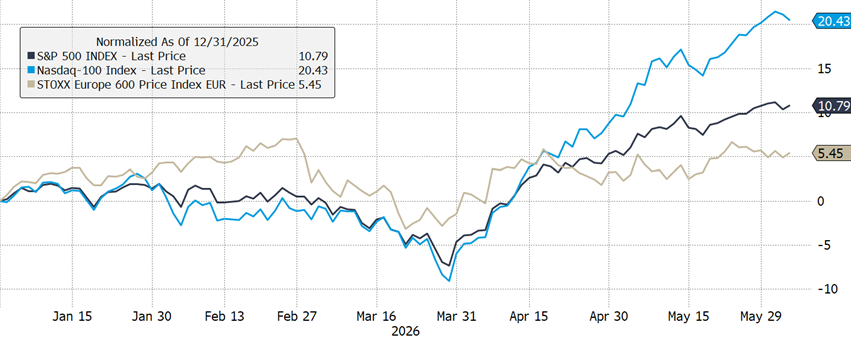
Despite the market signals regarding inflation and interest rates, equities have rebounded strongly since late March.
Source: Bloomberg
Nasdaq led the rally, outperforming the S&P by a factor of two and the European index by a factor of four. The Nasdaq’s gains were driven by tech companies, and while one might assume that the “Magnificent Seven” are once again the ones surging and driving the indices higher, that is not the case this time. Here is how they have performed so far this year:
- Alphabet (Google): +21.51%
- Amazon: +17.25%
- Apple: +14.79%
- Nvidia: +13.21%
- Tesla: -3.10%
- Meta: -4.18%
- Microsoft: -6.90%
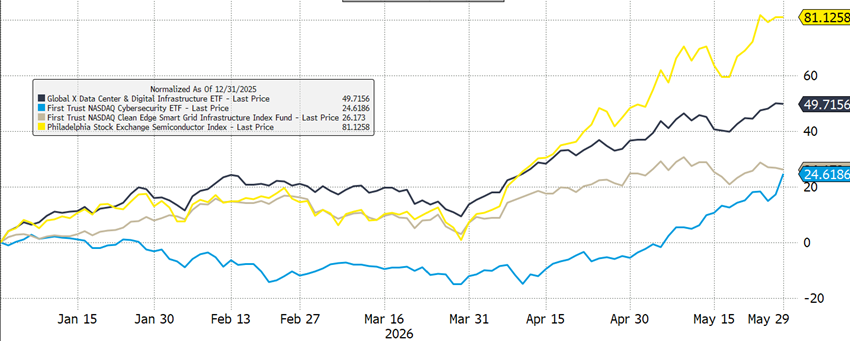
Only one of them outperformed the Nasdaq!, and three fell! But then, who is rising? We can no longer use the excuse that if you don’t own these seven, you won’t beat the market. Who has been leading the market? Between February, March, and April, there were announcements of these major companies’ estimated investment in artificial intelligence (AI) for 2026—80% more than in 2025—and who benefits? This chart shows the main beneficiaries: semiconductors, data centers, cybersecurity, and power grid infrastructure—and all of them have outperformed the Nasdaq.
Source: Bloomberg
And it’s not just in the United States; the global semiconductor index has risen 90% this year, and the MSCI Korea index has risen 128%, considering that just two semiconductor companies—Samsung and SK Hynix—account for 54% of the index. We already know who’s to blame.
I mentioned at the beginning that the stock market was rising despite the warning signs the market is giving us. What are those signals? The usual ones—those that have emerged with the tension in Iran. With the war, some commodities, especially oil, have skyrocketed. The Strait of Hormuz (it’s not exactly closed, but they’re allowing only very selective traffic), through which more than 20% of oil exports pass, has been closed for over three months. This problem, combined with the lower investment seen in recent years due to environmental concerns and lower estimated demand from China, has driven oil prices up to levels near $120. Reaching these prices is concerning, but what I believe poses the greatest risk to the economy as a whole is if prices stabilize at relatively high levels.
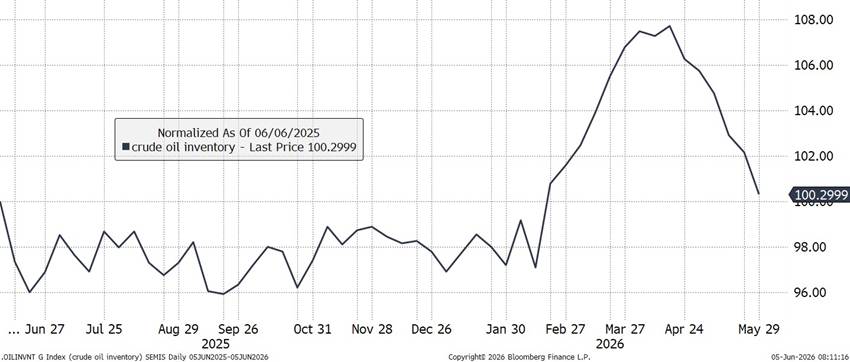
As a result of the prolonged closure of the Strait, global oil reserves have fallen substantially, as can be seen in this chart. With fewer reserves and lower exports, this creates tension between supply and demand, pushing prices upward.
Source: Bloomberg
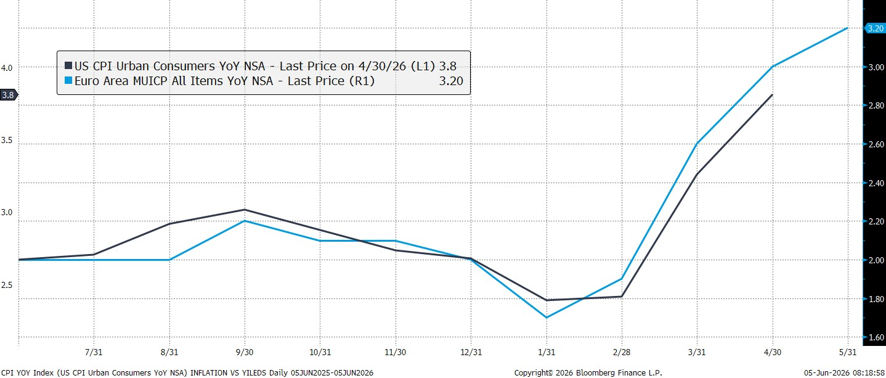
The impact on inflation data is already becoming apparent. Here you can see how inflation has risen this year in both the United States and Europe.
Source: Bloomberg
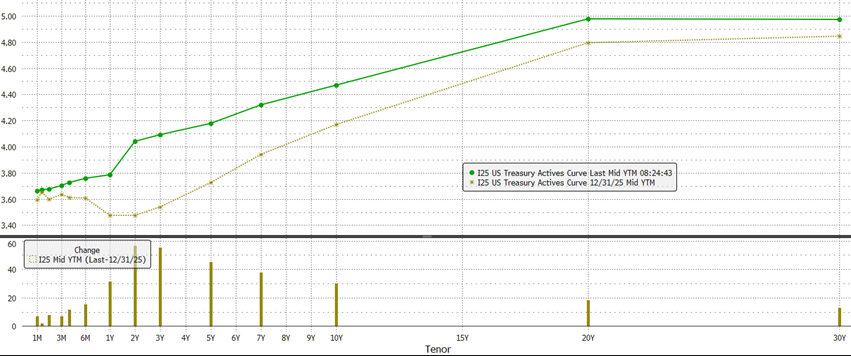
As a result, central banks are no longer considering cutting rates but rather raising them. Interest rates across nearly all maturities are rising. Here are the figures for the United States. The same is happening in the rest of the world. The green line shows interest rates for different maturities of U.S. Treasury bonds. The brown line shows the same data at the beginning of the year. Increases are evident across nearly all maturities. Investors perceive a risk of higher inflation in the medium and long term.
Source: Bloomberg
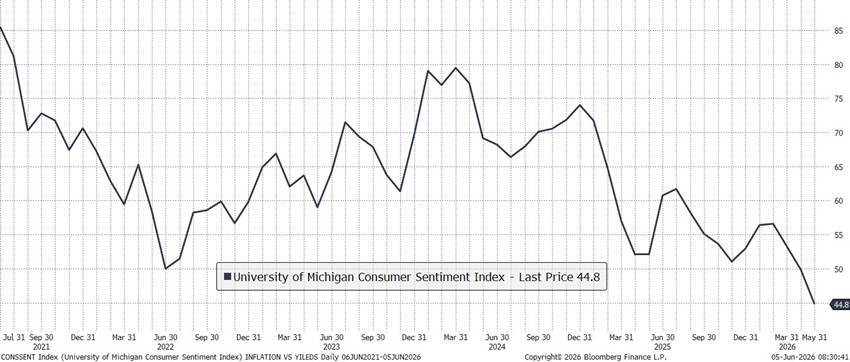
Such an environment affects consumers. The University of Michigan Consumer Sentiment Index[1] shows a downward trend, as can be seen in the image.
Source: Bloomberg
So, how is it possible for the market to rise given these somewhat concerning signals? The sectors seeing the biggest gains are those benefiting from heavy investment in AI—namely, semiconductors, data centers, power grid infrastructure, and cybersecurity—as well as commodities, which were already on the rise due to rising prices.
Major tech companies, especially the “Big Seven,” are taking on debt to invest in the new paradigm in a race to come out on top and claim the prize. The companies rising the most are not the big ones, as was previously the case, but the smaller ones. Take a look at the semiconductor sector of the Russell 2000 Index[2]. It’s up 97%.
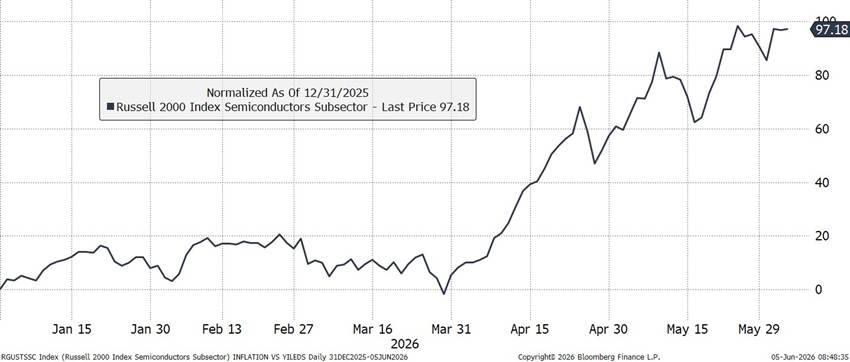
Source: Bloomberg
And take a look at how some of its components have evolved:
- Maxlinear: +440%
- Vishay: +339%
- Navitas: +329%
- Atomera: +309%
When compared to Nvidia, the world’s largest semiconductor company, which is projected to grow by 13% in 2026, this figure pales in comparison. It’s normal for these companies to see growth, but there may be a certain amount of euphoria involved, given that they are smaller companies with higher balance sheet risk. Please, I don’t mean to say that these are companies that are going to go bankrupt, but I do believe that these latest gains should be taken with a grain of salt.
“You will be like God, knowing good and evil”, Genesis 3:5.
On May 25, Pope Leo XIV’s first encyclical, Magnifica Humanitas, was published. It was signed on May 15, coinciding exactly with the 135th anniversary of Pope Leo XIII’s encyclical Rerum Novarum[3] in 1891. In it, he addressed the labor issues arising from the Industrial Revolution and laid the foundations for the Social Teaching of the modern Church.
If Rerum novarum helped us grasp the impact of the Industrial Revolution, Magnifica Humanitas offers insights into the human implications of today’s technological revolution.
I must say I really liked it because it helps analyze one of the most important trends for investors in the coming decades from a deeply human perspective in light of the Social Teaching of the Church.
It begins brilliantly, at least for me: “The magnificent humanity that God has created stands today before a decisive choice: to erect a new Tower of Babel or to build the city where God and humanity dwell together.”[4] Later, when discussing the building of the City of God, it refers to Nehemiah’s reconstruction of the walls of Jerusalem[5]
Babel symbolizes the pursuit of power for power’s sake, the impatience to achieve immediate results, and the illusion that technical progress is enough to save humanity. Nehemiah, on the other hand, shows us a different logic: that of a job well done, patience, responsibility, dedication, and the building of something that transcends self-interest.
Artificial intelligence has multiplied our capabilities in extraordinary ways. But the crucial question remains the same as it was thousands of years ago: whether we will use our talents to erect monuments to our own greatness or to build a more humane civilization.
Artificial intelligence is not evil in and of itself; it is a good servant but a bad master. What are we building—Towers of Babel or the reconstruction of Nehemiah’s walls of Jerusalem? I am not the one to answer this question, for I admit it would be very difficult for me, but I find great help in Mother Teresa’s response to the question, “Mother, if you could change one thing in the Church, what would you change?” She replied:
— I would change myself.
There is nothing more to say.
To read previous Market Reviews, click here.
[1] The University of Michigan Consumer Sentiment Index measures U.S. consumers’ confidence regarding their personal financial situation, the current economy, and their future economic expectations.
[2] The Russell 2000 is a stock market index that tracks the performance of approximately 2,000 U.S. small-cap companies.
[3] Rerum novarum (15 May 1891)
[4] Leo XIV, Magnifica Humanitas, n. 1.
[5] Leo XIV, Magnifica Humanitas, n. 8.